

Commentary
Christopher Shell
{
  "authors": [
    "Christopher Shell"
  ],
  "type": "commentary",
  "blog": "Emissary",
  "centerAffiliationAll": "dc",
  "centers": [
    "Carnegie Endowment for International Peace"
  ],
  "collections": [
    "American Statecraft and the Global South"
  ],
  "englishNewsletterAll": "americanStatecraft",
  "nonEnglishNewsletterAll": "",
  "primaryCenter": "Carnegie Endowment for International Peace",
  "programAffiliation": "ASP",
  "programs": [
    "American Statecraft"
  ],
  "projects": [],
  "regions": [
    "Haiti",
    "United States"
  ],
  "topics": [
    "Arms Control",
    "Security",
    "Migration"
  ]
}
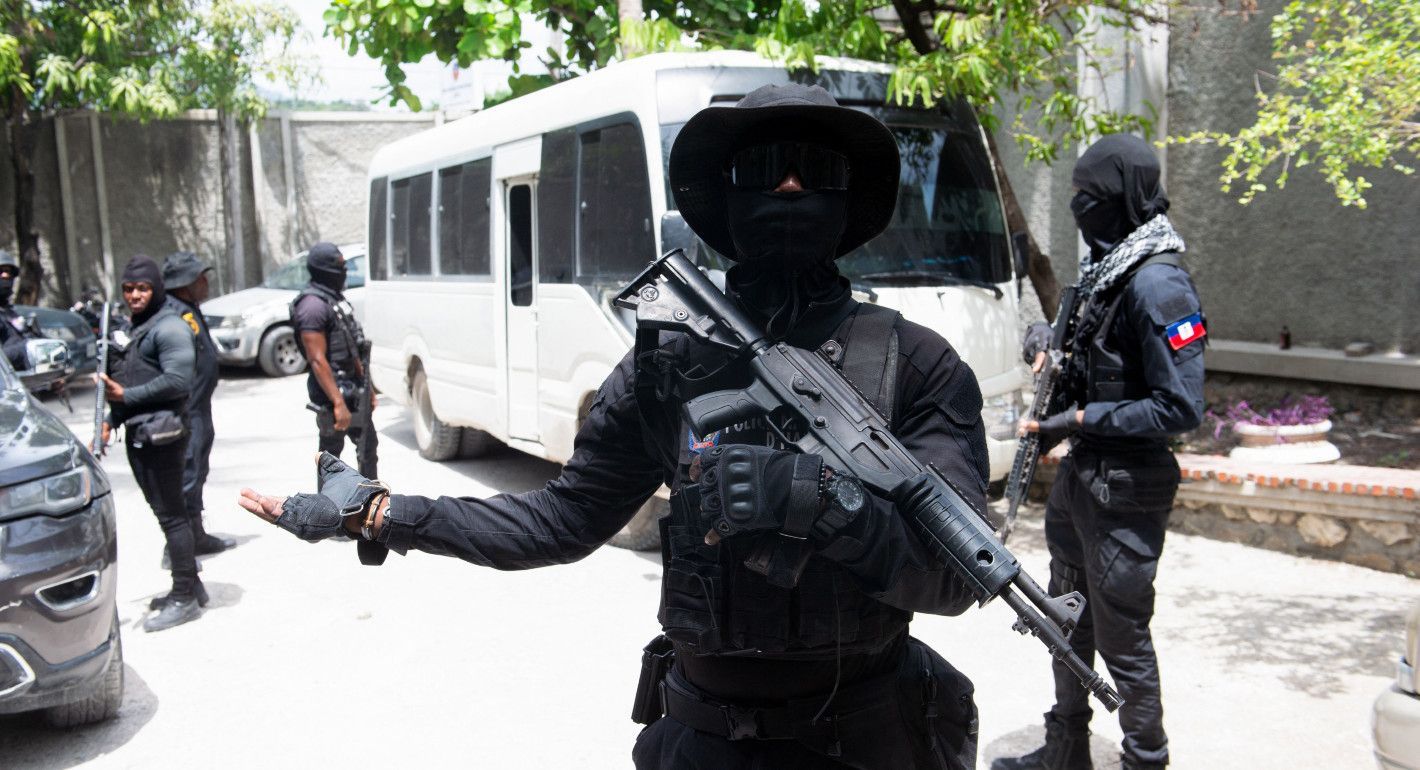
A police officer in Port-au-Prince, Haiti, on June 9, 2025. (Photo by Clarens Siffroy/AFP via Getty Images)
There’s a much more productive way to secure the border.
Last month, President Donald Trump’s administration announced plans to end deportation protections for roughly 500,000 Haitians currently residing in the United States—a safeguard initially granted under former president Joe Biden’s administration. A U.S. district judge has since blocked the move, offering a temporary yet critical opportunity to reflect on and potentially reconsider U.S. policy toward Haiti. The administration should use this moment to assess the root causes of irregular migration, as many Haitians have cited gang violence as their reason for their displacement. And because the unchecked flow of illegal firearms has facilitated the dominance of criminal gangs, primarily in Port-au-Prince, any serious attempt to stabilize Haiti should include curbing the supply of these weapons.
The security situation in Haiti has grown more dire since the arrival of the Kenyan-led Multinational Security Support (MSS) Mission in June 2024. The gangs now control an estimated 90 percent of Port-au-Prince, and their influence is spreading into the country’s southern regions. Nearly all efforts to suppress the gangs have thus far achieved limited results. The MSS remains underfunded and understaffed, and mounting casualties raise concerns about the mission’s long-term viability.
The Haitian government’s recent experiments with drone strikes on the gangs have yielded mixed outcomes, and the government is increasingly turning to private security contractors—though their impact remains to be seen. But these tactical interventions are overshadowed by the ready availability of weapons and ammunition, much of which originates in the United States.
Between 2020 to 2022, over 80 percent of the weapons seized in Haiti were of U.S. origin, largely smuggled through cargo shipments from South Florida. The illicit flow of weapons threatens stability not only in Haiti but also in the wider region. According to a 2024 Government Accountability Office report, 73 percent of guns recovered in the Caribbean trace back to the United States.
The administration has limited policy options to deal with this crisis. A boots-on-the-ground approach is politically untenable—especially with the Kenyan mission’s sustainability already in question. However, cracking down on arms trafficking is both feasible and can be politically palatable for policymakers on both sides of the aisle. Rather than deporting Haitians into a precarious situation, which could further inflame domestic divisions, increasing export controls and enforcement presents a less polarizing alternative. This approach may resonate with congressional Democrats, who have long cited the flow of U.S. weapons to Haiti as a destabilizing force, and with Republicans who favor tougher border security enforcement.
To this end, the Trump administration should consider a targeted use of Customs and Border Protection (CBP) resources to address the weapons flow. Under recent legislation, CBP is receiving a sizable budget increase: $5 billion for facility upgrades and $4 billion to hire additional personnel. But instead of spending the funds on arresting undocumented Haitians, they should be used to curb the illegal guns in outbound shipping containers, limiting the access of criminal gangs to U.S. weapons downstream. The administration should earmark some of these resources for South Florida to expand inspections of outbound cargo shipments—many of which leave port unscrutinized—and increase the use of cargo scanners, among other tactics.
Regional cooperation is also critical. The Dominican Republic’s 240-mile border with Haiti serves as another entry point for illicit arms. For instance, in March 2025, Dominican authorities seized 36,000 cartridges and twenty-four firearms—including a .50 caliber sniper rifle capable of piercing an armed vehicle—from a Miami shipment destined for Haiti. The Trump administration should deepen bilateral coordination with the Dominican Republic, including deploying enhanced scanning technology at key shipping Dominican Republican ports and deploying CBP personnel to train local customs officials on identifying and interdicting illicit firearms shipments.
None of this will be easy, but it is far more pragmatic and humane—and less politically costly—than mass deportations of people back to what is ostensibly a war zone. The administration must recognize that deportation without stabilization is not a solution, but a short-term fix with likely long-term consequences. Such a decision may not advance the administration’s stated goal of restoring basic stability in Haiti—stability that would, in turn, ease irregular migration pressures on the southern U.S. border and limit political divisiveness at home.
A policy that disarms Haiti’s gangs by disrupting their access to U.S.-made firearms would directly support the administration’s broader goals of security and fostering stability that makes irregular migration less appealing.
If the Trump administration wants to project strength and competence in handling foreign policy challenges in the Western Hemisphere, the place to start is with the controllables. And right now, that means making use of the increased resources to U.S. institutions and clamping down on the supply lines that arm the gangs—before sending vulnerable people back into the quagmire they fled from.
On Thursday, July 17 at 1 p.m. EDT, join the author for an online panel on the future of U.S-Haiti policy. For more, click here.
Fellow, American Statecraft Program
Christopher Shell is a fellow in the American Statecraft Program at Carnegie Endowment for International Peace.
Recent Work
Christopher Shell
Christopher Shell
Carnegie does not take institutional positions on public policy issues; the views represented herein are those of the author(s) and do not necessarily reflect the views of Carnegie, its staff, or its trustees.
The groundbreaking legislation faces an uphill battle, but it creates a framework for others to follow—especially as the effects of climate change intensify.


Liliana Gamboa, Kayly Ober

In Colombia and elsewhere in the region, the United States is trying to shape election outcomes—but at what cost?

Oliver Stuenkel, Adrian Feinberg

By burying disagreements in imprecision, the new deal risks same fate as its predecessors.

James M. Acton
The United States and Israel may have unwittingly revived the Islamic Republic’s “zombie regime.”



Suzanne Maloney, Aaron David Miller, Karim Sadjadpour
Natural disasters are no longer local incidents but sources of systemic risk that threaten vital infrastructure and the economy—and public support for international engagement.

Leonardo Martinez-Diaz